Manufacturing Operations Overview
End-to-end discrete and process manufacturing management tailored for Ethiopian industrial enterprises.
1. Overview & Business Value#
This comprehensive operational guide details the architecture, business workflows, configuration parameters, and execution steps for Manufacturing Operations Overview within SmartERP.
End-to-end discrete and process manufacturing management tailored for Ethiopian industrial enterprises.
{screenshot:overview-overview-dashboard}
2. Prerequisites & Security Access Groups#
- Required Modules:
mrp, quality_control, smarterp_manufacturing_costing - Security Groups:
Manufacturing User(Technical ID:mrp.group_mrp_user)Manufacturing Administrator(Technical ID:mrp.group_mrp_manager)Quality Inspector(Technical ID:quality.group_quality_user)
- Master Data Dependencies: Bills of Materials (BoM), routing operations, work centers with machine/labor hourly rates, raw material stock, and inspection checkpoints.
3. Step-by-Step Configuration & Execution#
Step 1: Navigating to the Module Interface#
- Log into your SmartERP instance at
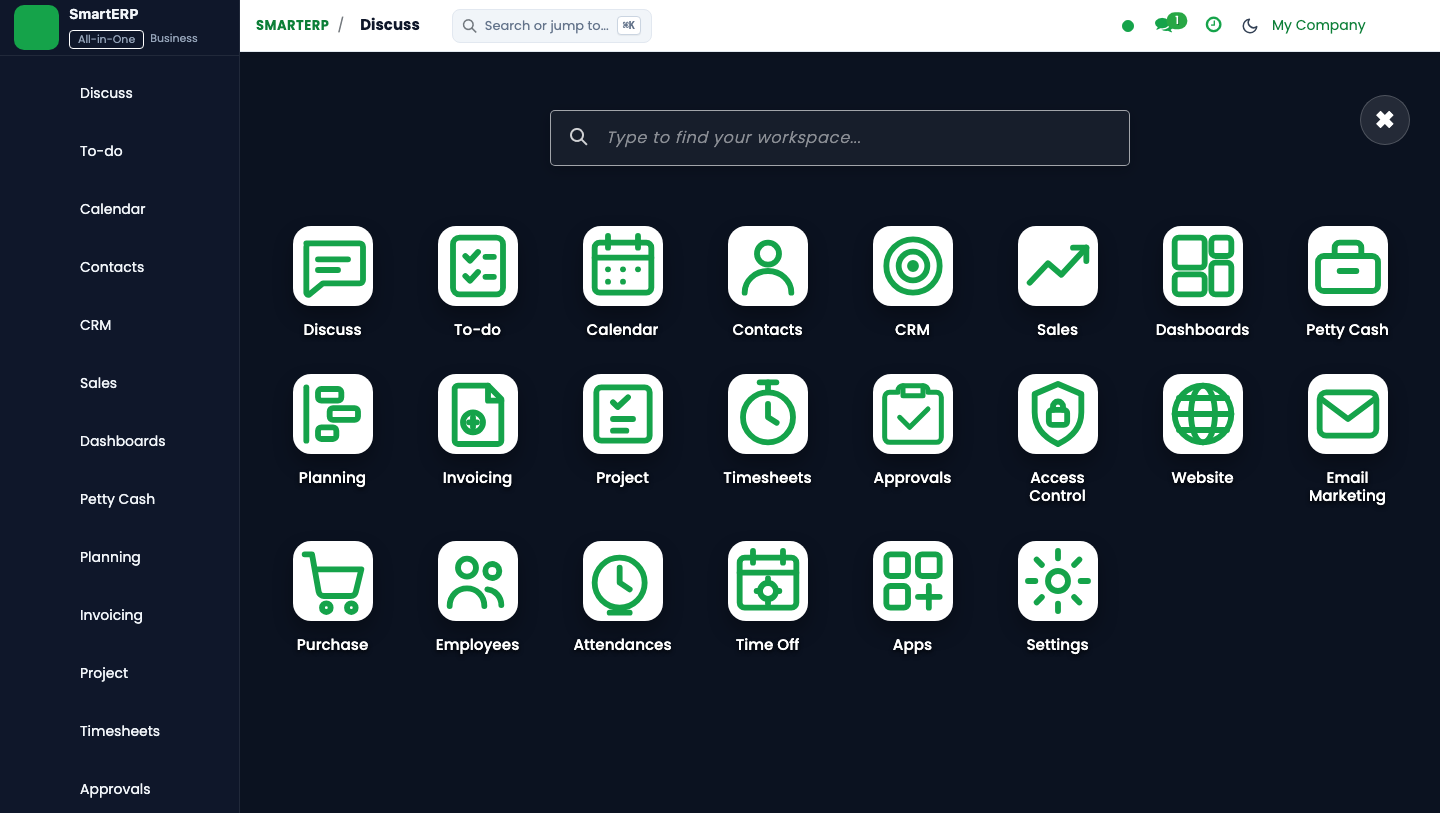
https://smarterp.et/odoo. - Open the main App Switcher (grid icon in the top-left corner).
- Select the Manufacturing app icon.
- From the top navigation bar, open Manufacturing → Operations → Manufacturing Orders / Work Orders; Quality → Quality Control.
{screenshot:overview-app-switcher-navigation}
Step 2: Creating and Parameterizing Records#
- Click the New button in the top-left control panel.
- Complete the mandatory fields in the record form:
- Finished Product (Mandatory): Manufacturable item variant linked to an active Bill of Materials
- Quantity to Produce (Mandatory): Target production batch volume in standard unit of measure
- Bill of Materials (BoM) (Mandatory): Active engineering recipe defining component roll-ups and operation steps
- Scheduled Date (Mandatory): Target production execution date and shift allocation
- Configure optional operational parameters and localized tags as required:
- Work Center Routing (Optional): Specific shop floor machine or assembly station sequence
- Lot / Serial Number (Optional): Assigned traceability lot for finished goods batch tracking
- Analytic Cost Account (Optional): Cost absorption center for direct labor and utility overhead
- Click the Save icon in the control bar to commit the record.
{screenshot:overview-record-creation-form}
Step 3: Validating and Processing Transactions#
- State Transitions: Execute operational state progression (Draft → Confirmed → In Production → Quality Gate Passed → Done → Cost Closed).
- Ledger & System Impact: Consumes raw materials from inventory (crediting stock valuation), absorbs labor/machine overhead, and debits finished goods inventory at actual cost.
- Audit Verification: Automated recording of author ID, timestamp, and immutable revision history.
{screenshot:overview-transaction-processing-state}
Industrial Manufacturing in Ethiopia#
SmartERP Manufacturing delivers an enterprise-grade execution, planning, and cost accounting platform built specifically for Ethiopian discrete and process manufacturers. Whether operating inside federal industrial parks (such as Hawassa, Bole Lemi, Kilinto, or Kombolcha) under Ethiopian Investment Commission (EIC) customs-bonded regimes or managing commercial processing plants across the nation, SmartERP bridges shop floor operations with real-time financial accounting and statutory compliance.
The system unifies multi-level Bills of Materials (BoMs), work center capacity scheduling, shop floor tablet execution, quality assurance gates, and automated Work-in-Progress (WIP) cost absorption.
[mrp-module-map]
Key Manufacturing Capabilities#
| Functional Domain | Core Capability | Ethiopian Business Relevance |
|---|---|---|
| Bill of Materials (BoM) | Multi-level engineering BoMs, phantom kits, co-product allocation | Accurate raw material recipe management compliant with Ethiopian Conformity Assessment Enterprise (ECAE) standards |
| Material Issuance | Automated Store Issue Voucher (Model 20 SIV) generation | Full alignment with Ministry of Finance store governance rules for stock relief |
| Shop Floor Execution | Real-time work order timers, barcode tracking, operator tablet UI | Accurate direct labor capture and worker shift tracking under Ethiopian Labour Proclamation 1156/2019 |
| Cost Absorption | Standard vs actual cost roll-up, machine overhead, WIP ledger | Continuous valuation of WIP and Finished Goods for Proclamation 979/2016 corporate income tax filings |
| Quality Control | In-process quality control points, pass/fail tolerances, NCRs | ISO 9001 and ECAE quality certification documentation |
| Subcontracting | Toll manufacturing, external processing, tracked drop-shipments | Seamless operations with specialized local or foreign external processing vendors |
Regulatory and Compliance Baseline#
Ethiopian industrial manufacturers face strict statutory requirements regarding raw material import tariffs, bonded warehouse reconciliation, and corporate income tax deductions:
- Customs Bonded Warehouses & Input-Output Ratios: Under Ethiopian Customs Commission regulations, manufacturers operating under voucher schemes or duty-drawback regimes must justify raw material imports against actual production yields. SmartERP tracks exact yield ratios and spoilage percentages on every production run.
- Ministry of Finance Model 20 (SIV) and Model 19 (GRN): Raw materials cannot be released from raw material stores to the plant floor without an official Store Issue Voucher (Model 20 SIV). Similarly, completed goods must be officially posted into the warehouse via a Goods Receiving Note (Model 19 GRN). SmartERP automates this voucher creation upon work order release and completion.
- Labour Proclamation 1156/2019: Direct manufacturing labor timesheets conform to statutory maximum working hours (8 hours/day, 48 hours/week) and legal overtime multipliers (1.5x, 2.0x, 2.5x) feeding directly into payroll.
[mrp-production-lifecycle]
System Navigation and Cockpit#
Access the manufacturing workspace via Manufacturing > Operations > Manufacturing Orders. The home dashboard presents visual KPIs for open orders, work center load, component stockout warnings, and Overall Equipment Effectiveness (OEE).
4. Advanced Configuration Points#
- Automated Actions & Scheduled Tasks (Crons):
MRP: Recalculate BoM standard costs(mrp.ir_cron_bom_cost_roll): Runs weekly to update standard costing from latest procurement purchase pricesQuality: Trigger periodic inspection alerts(quality.ir_cron_inspection_check): Runs daily to flag mandatory quality testing queuesWorkcenter: Update OEE statistics(mrp.ir_cron_workcenter_oee): Runs hourly to compute Overall Equipment Effectiveness metrics
- Custom Print Templates & Reports:
- Production Order Traveler & Pick List
- Shop Floor Work Order Execution Slip
- Quality Inspection Certificate & Non-Conformance Report
- Manufacturing Cost Analysis & Variance Ledger
- Multi-Company Rules: Record-level security isolation under Company 1 (
Ashewa Technology Solutions S.C.), preventing cross-company ledger leakage across parent and subsidiary legal entities.
5. Comprehensive Troubleshooting Matrix#
| Error Symptom / Exception | Probable Root Cause | Corrective Action / Resolution |
|---|---|---|
BoM Missing Error: No active Bill of Materials found | Product variant lacks a verified and confirmed BoM in the system. | Create and confirm an active BoM under Manufacturing → Products → Bills of Materials. |
Component Shortage Block: Insufficient stock | Raw material components have not been transferred to the shop floor location. | Execute an internal transfer from main warehouse to production staging location. |
Quality Gate Blocked: Mandatory test failed | Work order failed critical quality tolerance threshold. | Perform required corrective rework or request authorized Quality Manager override. |
Workcenter Capacity Overload | Scheduled production duration exceeds available work center shift capacity. | Adjust scheduled start dates or distribute load across alternative work centers. |