One platform for the whole business
SmartERP by Ashewa is a connected business platform — sales, purchasing, inventory, accounting, manufacturing, HR, projects and web on one set of records — built on modern enterprise architecture and implemented, supported and extended by Ashewa Technology Solutions S.C. in Addis Ababa.
Why one platform
Departments stop working in separate silos
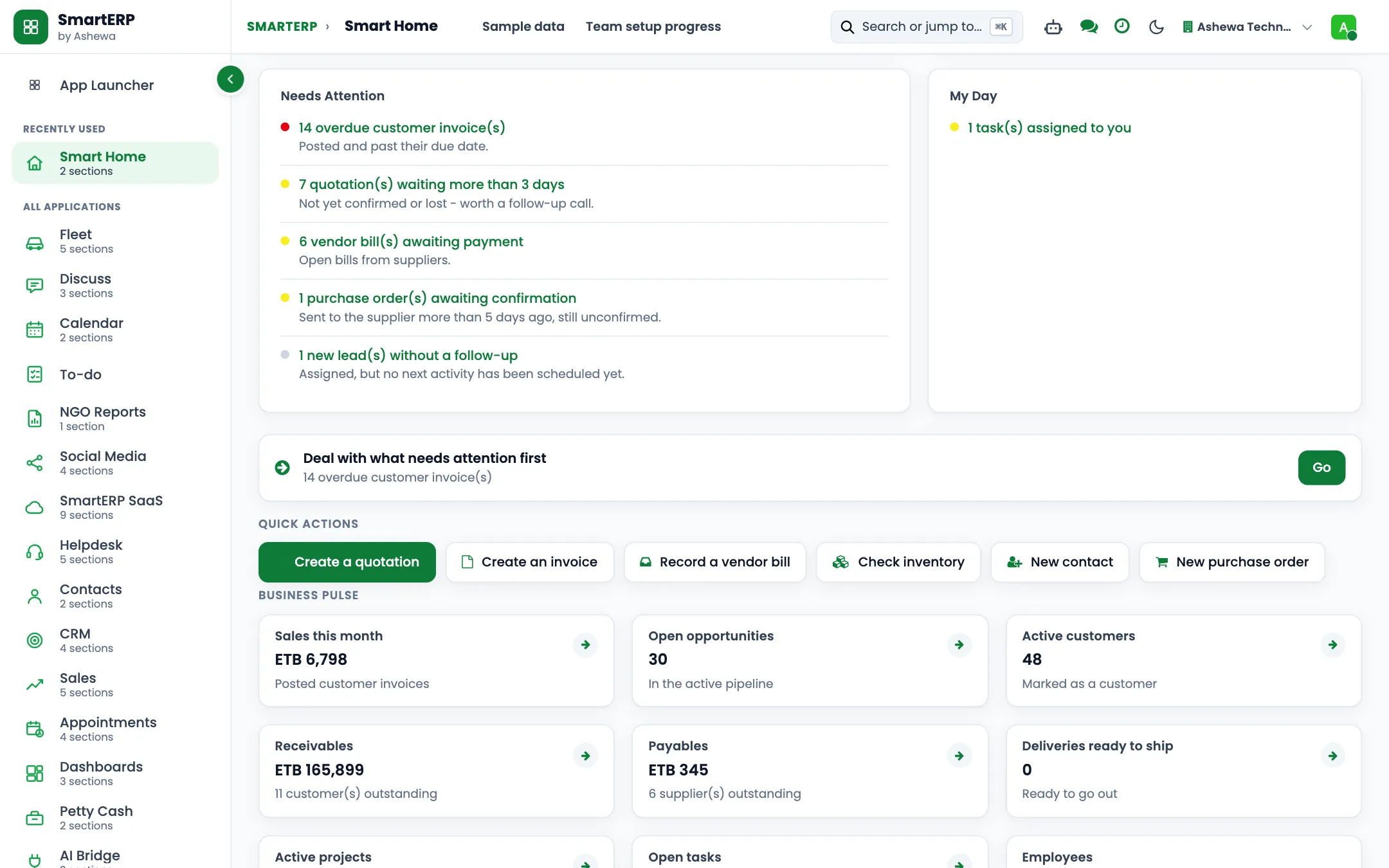
A quotation becomes a delivery, an invoice and a ledger entry without re-typing. Single source of operational truth for directors and staff.
Connected operations
Sales, stock, purchasing, accounting, HR and projects share one set of records with zero duplicate data entry.
Management visibility
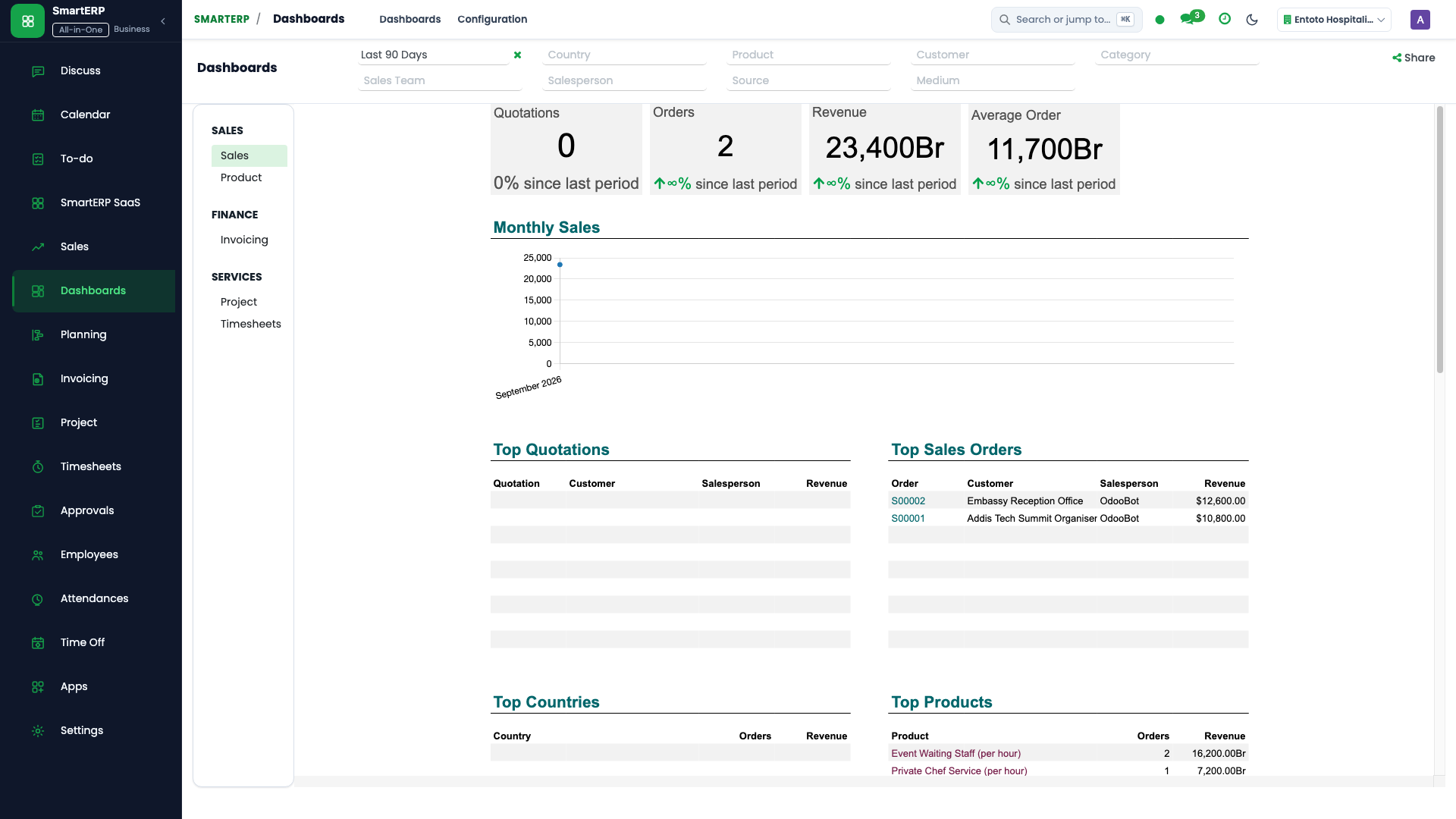
Real-time P&L, balance sheet, inventory valuation, and cash flow across branches and warehouses instantly.
Modular growth
Start with core accounting and sales today, and seamlessly activate inventory, manufacturing, or payroll as you expand.
Extensible & Local
Custom workflows, Telebirr/CBE bank payment integration, and tailored Ethiopian regulatory reporting.
Connected workflows
See how the applications hand work to each other
Click through our four core operational lifecycles to see how automated handoffs eliminate manual reconciliation.
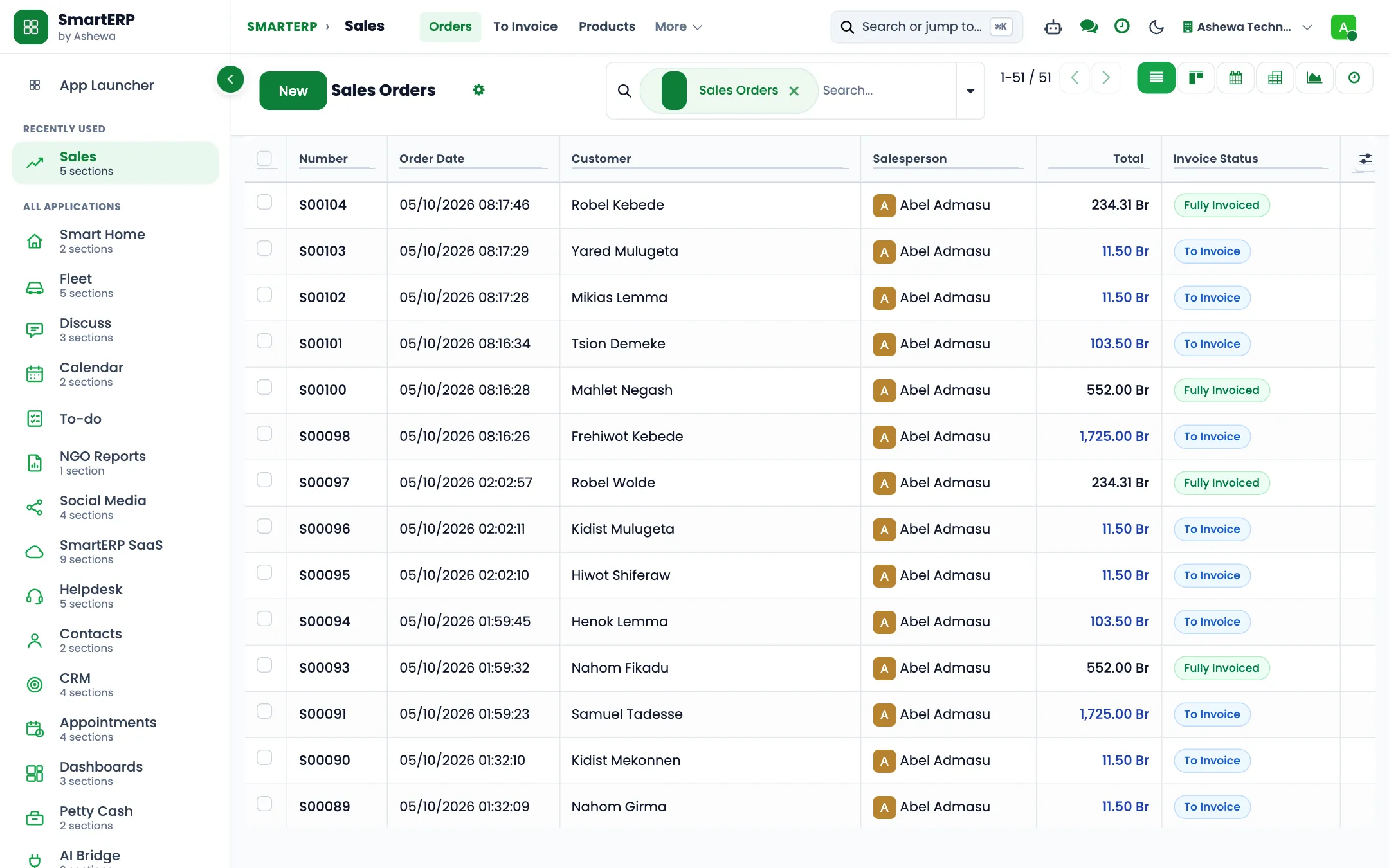
1. Lead
Capture in CRM
2. Opportunity
Qualify deal stages
3. Quotation
Send ETB quote
4. Sales Order
Confirm order
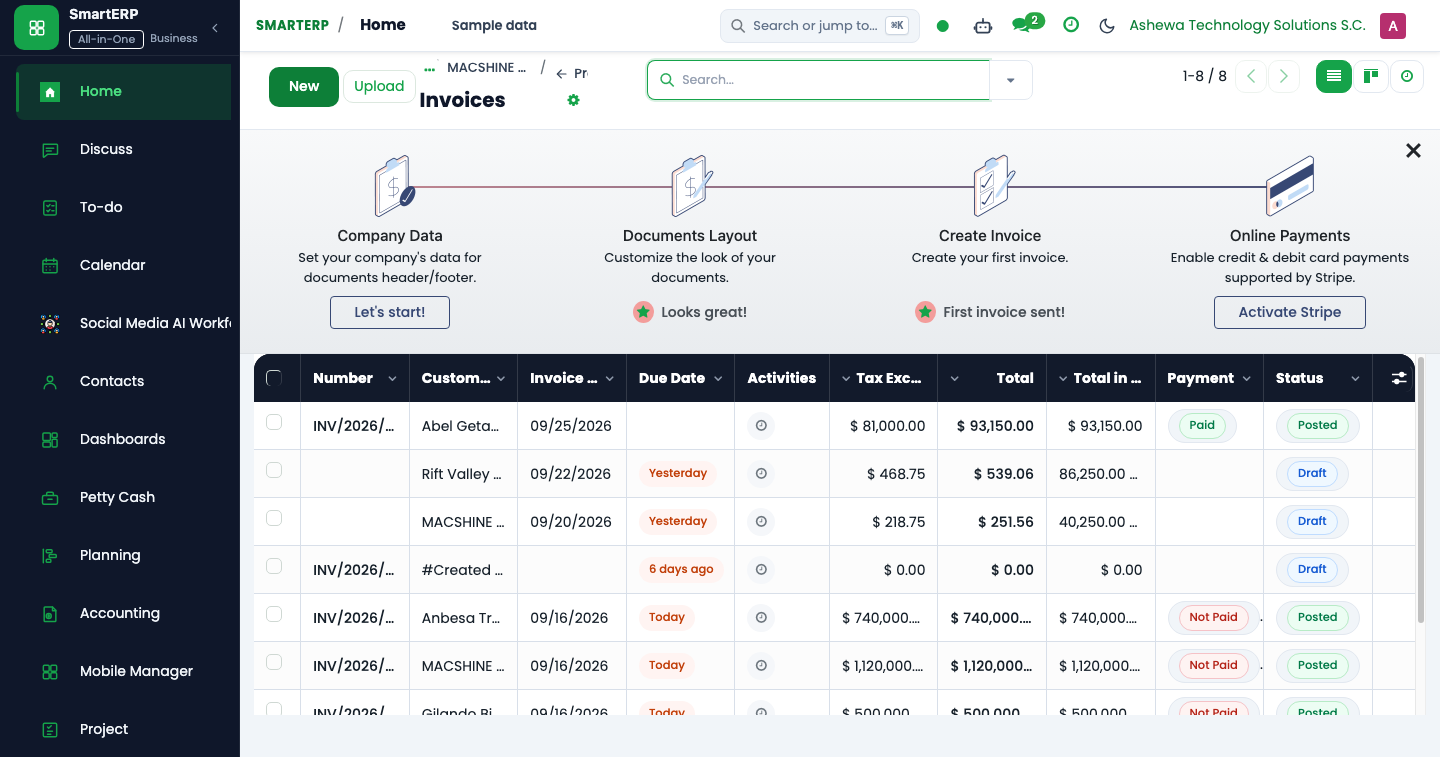
5. VAT Invoice
15% VAT calculation
6. Payment
Auto-reconciliation
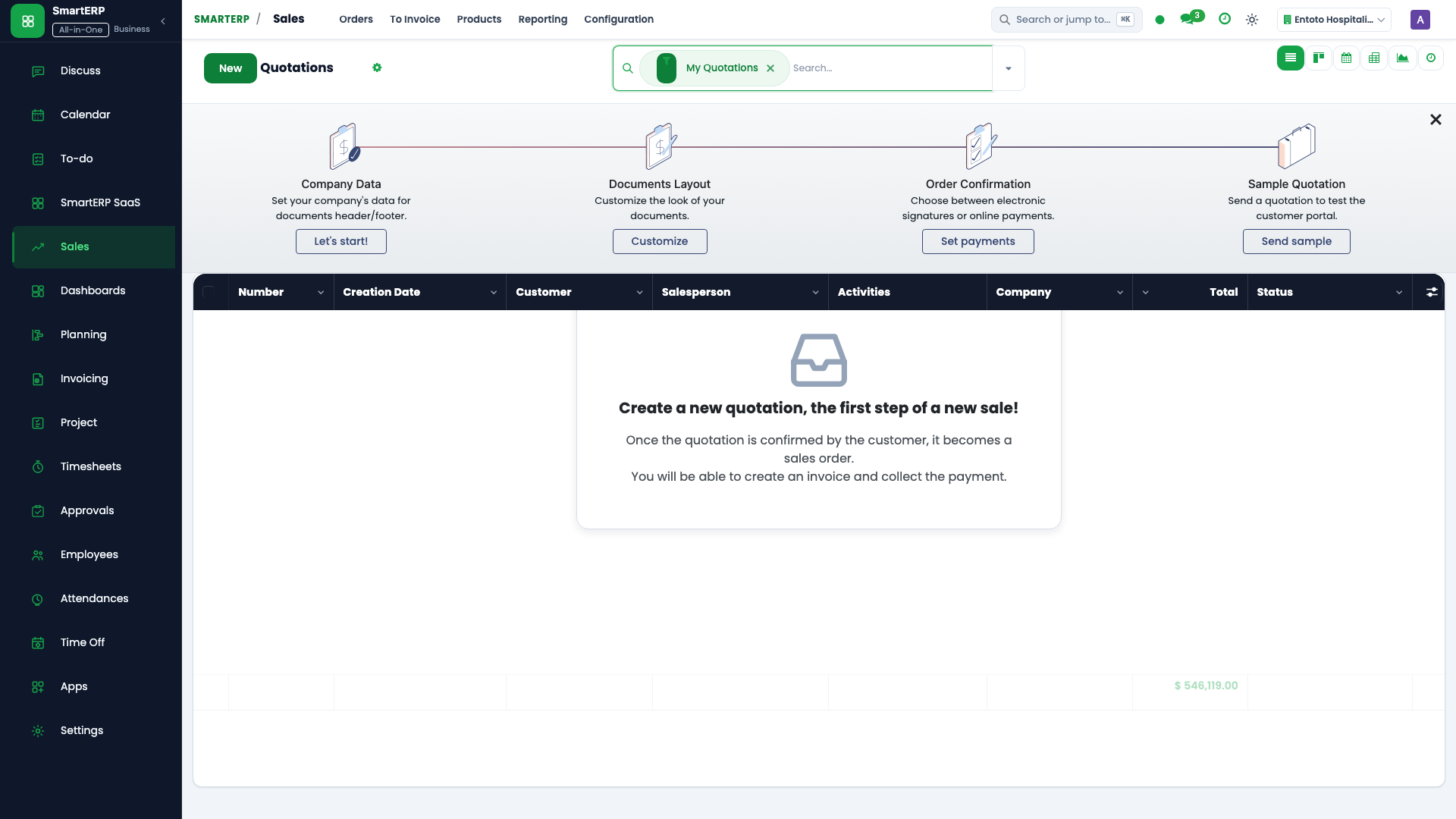
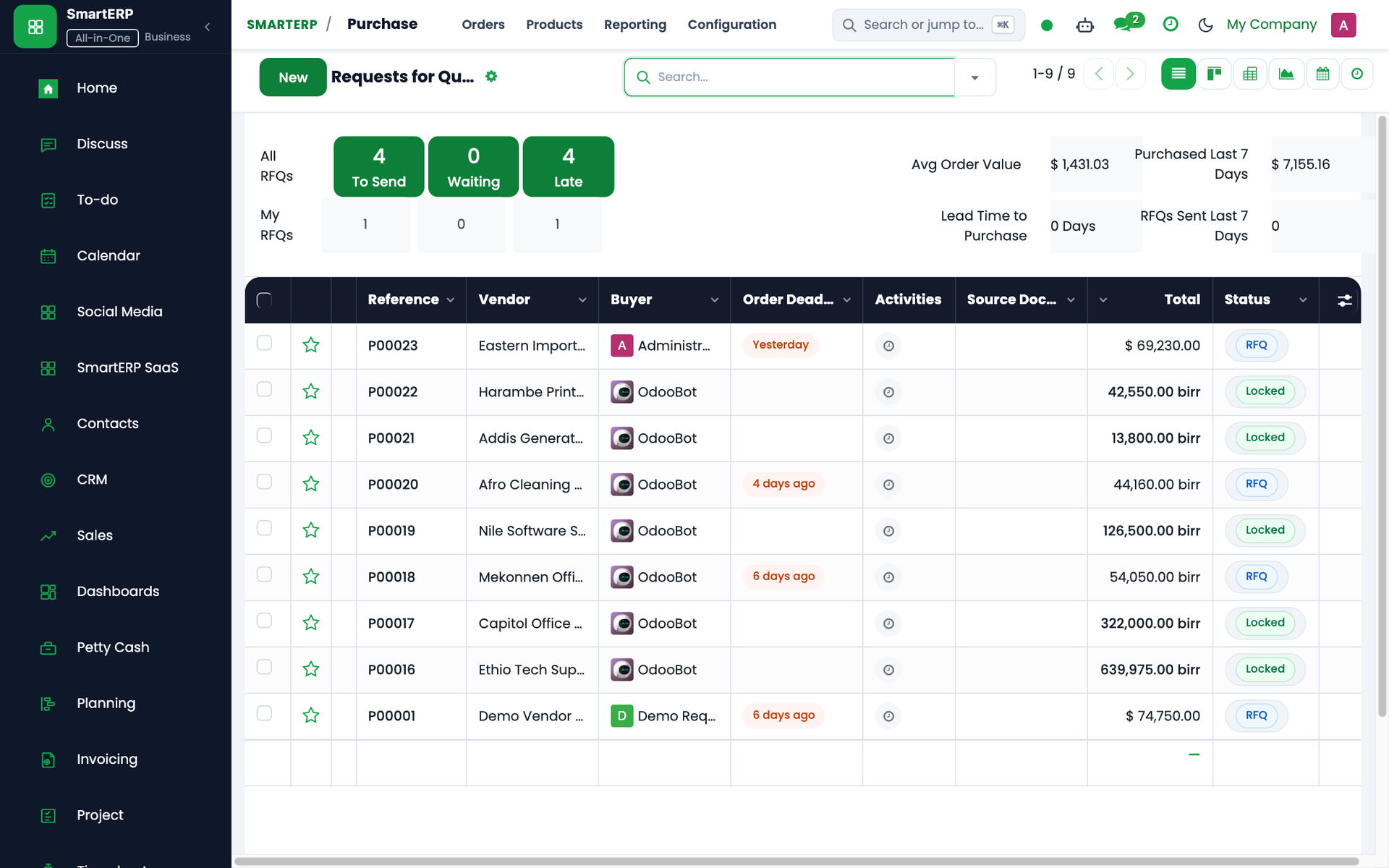
1. Purchase Order
RFQs & PO confirmation
2. Stock Receipt
Warehouse intake
3. 3-Way Matching
PO vs Receipt vs Bill
4. Vendor Bill Payment
Settlement in ETB/USD
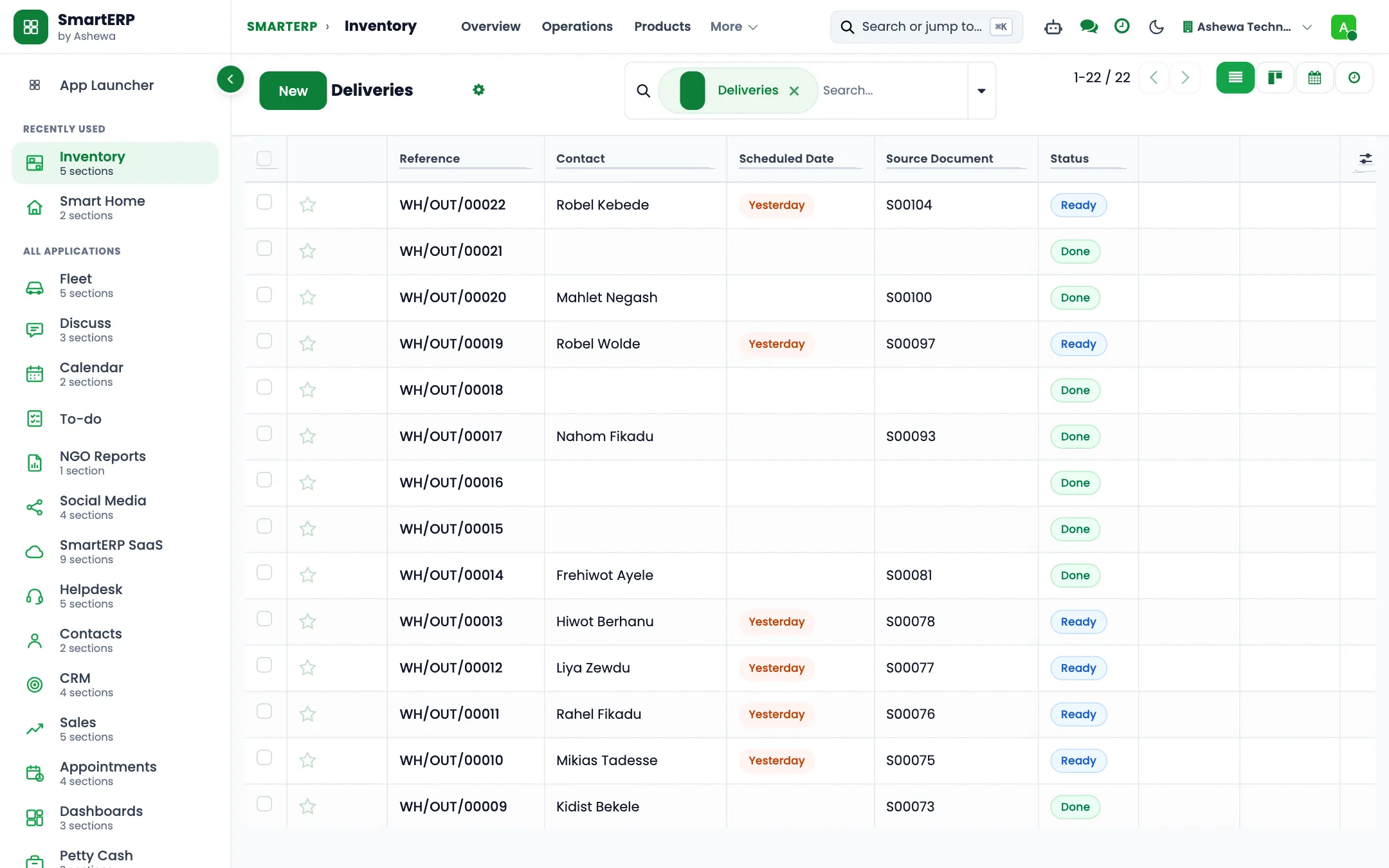
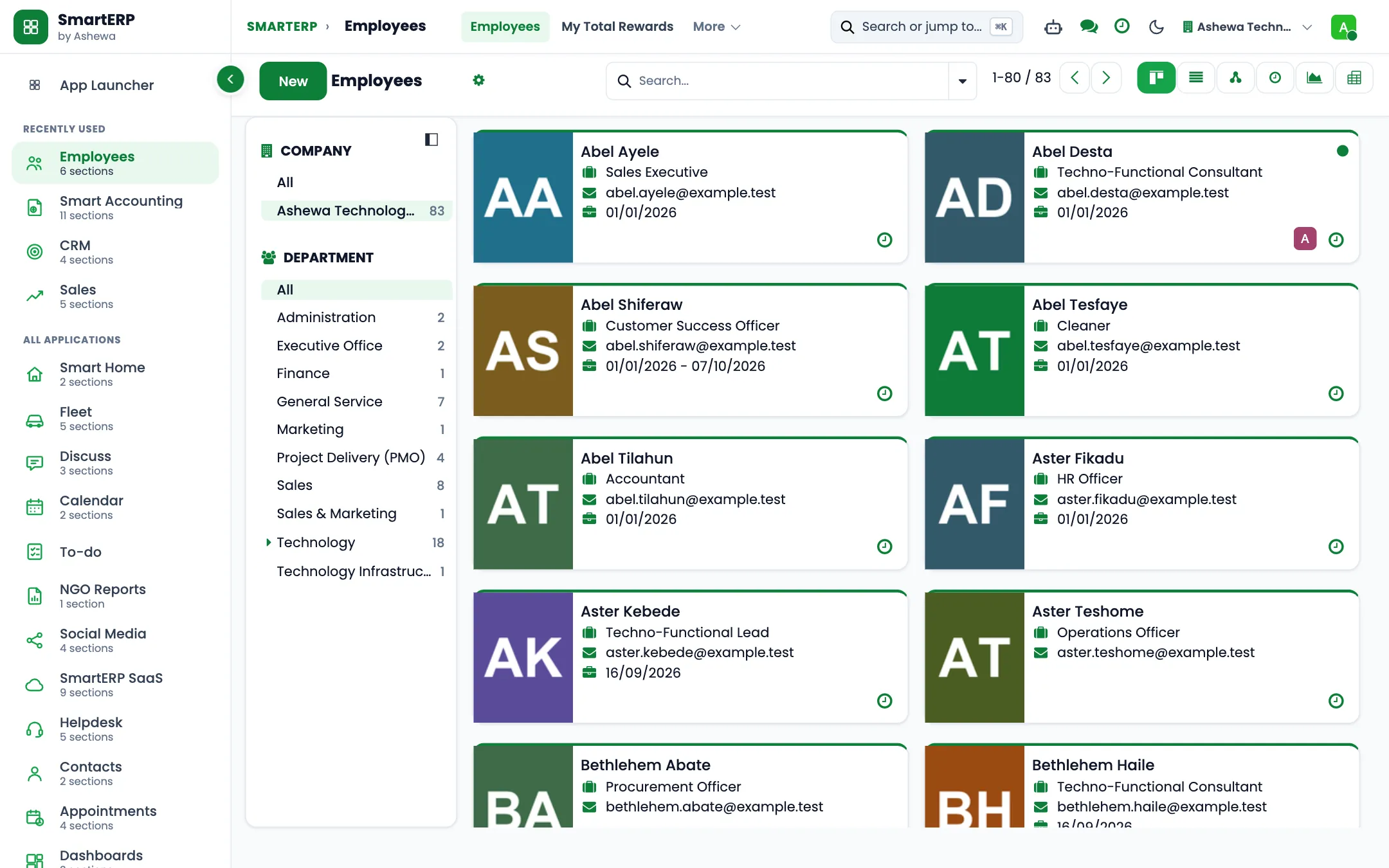
1. Recruitment
Job posts & candidates
2. Employee
Contracts & profiles
3. Attendance
Biometric integration
4. Time Off
Leave requests & balances
5. Payroll (ETB)
Tax & pension calculation
1. Transactions
Recorded once at source
2. Shared Data
Unified general ledger
3. Live BI Reports
Real-time pivots & graphs
4. Executive Action
Current numbers, no lag
AI Intelligence Suite
SmartERP AI: Autonomous Agents, Copilot & Intelligence
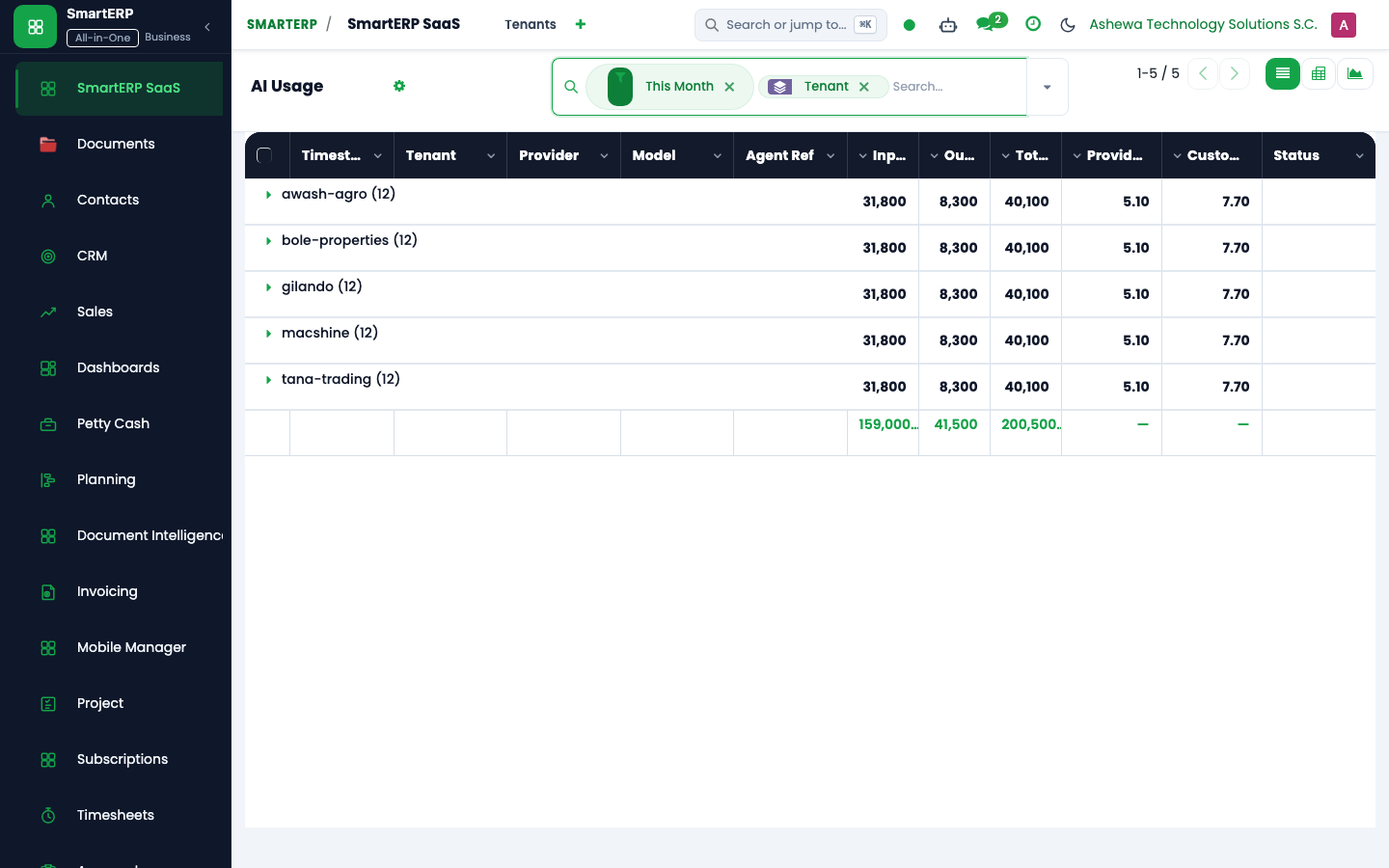
Experience enterprise artificial intelligence embedded natively into your transactional workflows. SmartERP connects large language models directly to your operational records without data leaks.
Smart Business Analyst
Ask questions in plain English or Amharic ("What was our gross margin in Mekelle last quarter?") and receive instant charts and drilldown pivots.
Autonomous AI Agents
14 specialized autonomous agents that qualify inbound CRM leads, triage customer support tickets, and draft follow-up debt collection notices. Explore AI Agents →
AI Website & Landing Page Builder
Generate full responsive product pages and lead generation funnels automatically based on your product catalogue. Explore AI Builder →
Foundation
Why built on modern enterprise architecture — Proven, Open, and Enterprise-Ready
Rather than a closed proprietary silo, SmartERP builds upon the battle-tested Odoo 17 Community foundation — giving you unmatched stability, open standards, and zero vendor lock-in.
What SmartERP Adds
- Ethiopian Localization: Ethiopian Calendar, Amharic translations, 15% VAT, and withholding tax ledgers.
- Local Cloud Hosting: Dedicated Ashewa Cloud servers in Addis Ababa for low latency and high reliability.
- Addis Ababa Engineering Team: On-site business analysts, training specialists, and dedicated technical support.
- Industry Packages: 50+ pre-configured Ethiopian industry verticals (Hospitality, Trading, School, Construction, Healthcare).
Not Just a Licence
You partner with an enterprise team accountable for your business success — not a software licence you are left to configure alone.
Our implementation methodology includes data migration from legacy spreadsheets, chart of accounts setup, staff training workshops, and post-go-live stabilization.
Local by design
Set up for how businesses in Ethiopia work
We designed SmartERP around the day-to-day regulatory and commercial realities of Ethiopian enterprises.
-
Ethiopian Birr & 15% VAT: ERCA-compliant tax breakdown, customer invoices, and vendor withholding certificates.
-
Ethiopian Chart of Accounts: Standardized COA tailored for Ethiopian commercial, import/export, and manufacturing businesses.
-
Bilingual Amharic & English: User interface and transactional documents supported in both languages.
-
Addis Ababa Support & SLA: Goro, ICT Park, BPO center Building, 1th Floor headquarters with on-site deployment engineers and telephone helpline (+251 922 612024 / +251 90 970 7709).
What is included
The applications on the platform
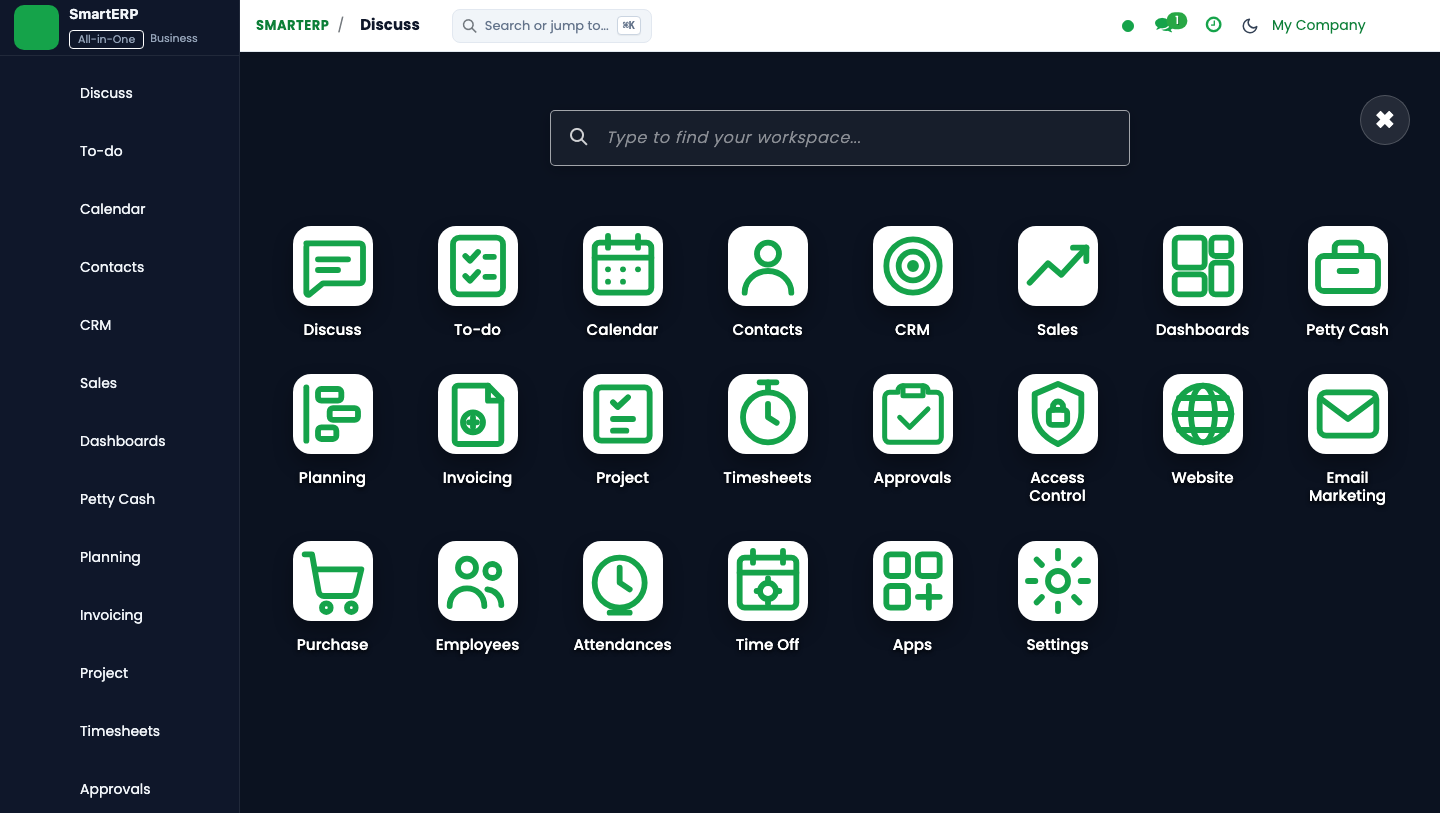
Every application is natively integrated into the same database. Click any module to explore its capabilities.
Finance & Accounting
Automated general ledger, accounts payable, accounts receivable, and bank reconciliation.
Sales & CRM
Lead capture, visual opportunity pipelines, customer quotes, and counter sales.
Operations & Stock
Double-entry inventory, barcode scanning, procurement RFQs, and dispatch logistics.
Manufacturing (MRP)
Multi-level Bills of Materials (BOM), work center routings, and production scheduling.
People & HR
Complete employee lifecycle from applicant tracking to Ethiopian payroll calculation.
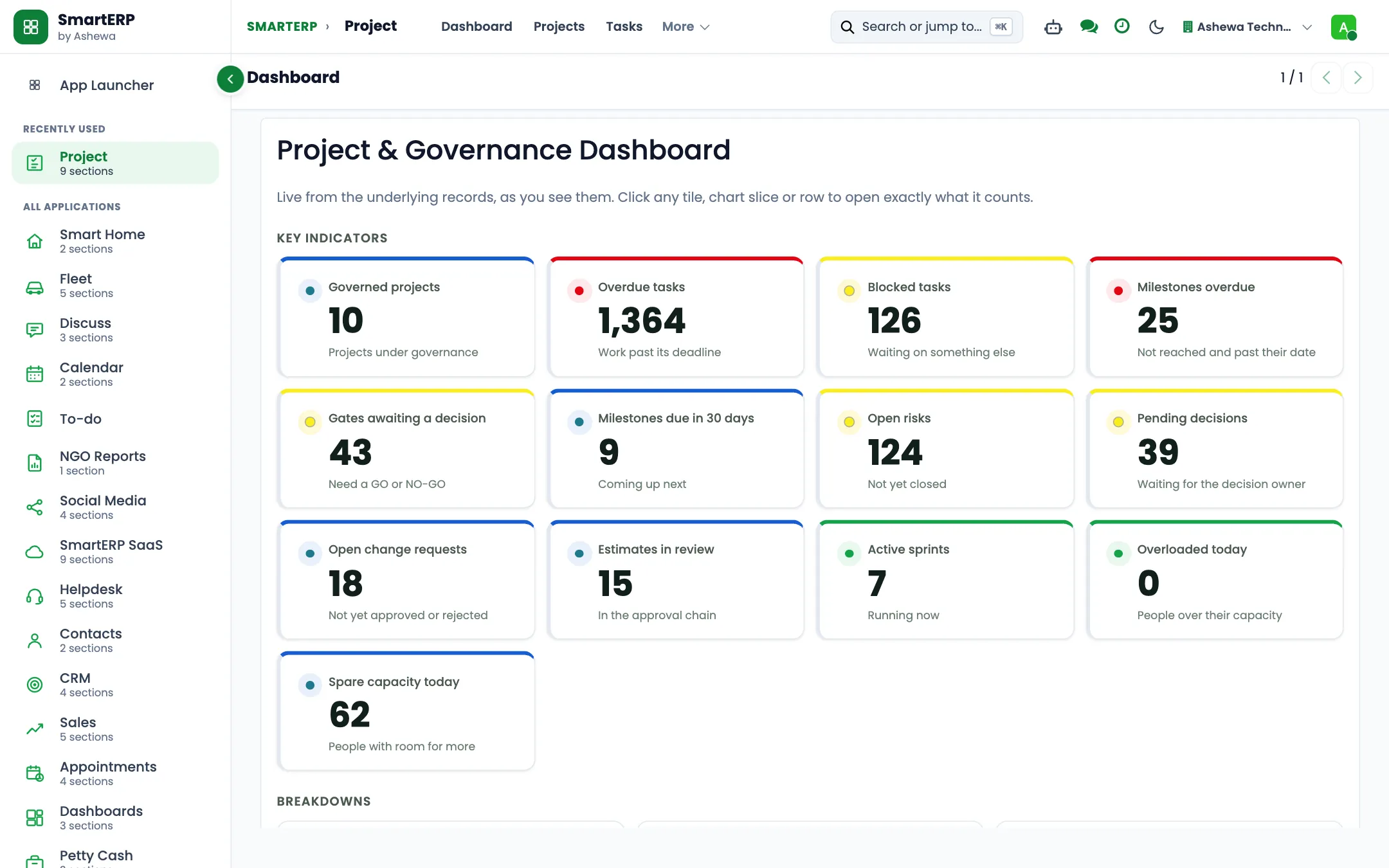
Projects & Service
Gantt timelines, employee timesheets, customer support tickets, and service SLAs.
Hosting and data
Where your system runs, and who controls the data
Deployment Options
Hosted on Ashewa Cloud in Ethiopia, on your own on-premise servers, or on international cloud infrastructure — your choice. We give you total freedom of deployment architecture.
Your Data Sovereignty
Each SmartERP customer operates on a private database with daily automated backups. You are the sole administrator and owner of your system. See Security & Trust.
Availability
What is available today, and what is coming
Clear, honest status for every capability across the SmartERP platform.
| Capability | Status | What it means | Details |
|---|---|---|---|
| Cloud Hosting (SaaS) | Available | Private database per customer, daily backups, 14-day trial. Hosted on Ashewa Cloud. | Details |
| Reports & Dashboards | Available | Live BI dashboards, financial pivots, and graphical operational reports. | Details |
| AI Intelligence & Agents | Available | 14 autonomous AI agents, AI Copilot, and AI Website Builder. | Details |
| Local Payment Integrations | Available | Telebirr, CBE Birr, Chapa gateway, and bank wire reconciliation. | Details |
| Planning & Project Controls | Available | Resource planning, agile sprint management, and project P&L governance. | Details |
| Mobile & Tablet Access | Available | Responsive mobile browser access & Progressive Web App (PWA) support. | Details |
Talk to SmartERP
Take the first step toward unified business operations
Our enterprise team in Addis Ababa will configure a live walkthrough for your industry.